

For decades, the healthcare system has treated physical and mental health as separate entities. If a patient visited their primary care physician (PCP) experiencing severe physical symptoms alongside anxiety or depression, the standard response was a paper referral to an external psychiatric specialist.
Unfortunately, this siloed approach has created a massive care bottleneck. Patients often face months-long waiting lists for psychiatric appointments, while PCPs—acting as the de facto first-responders for the mental health crisis—experience high rates of professional burnout trying to manage complex psychiatric cases without specialized support.
As we move through 2026, the clinical consensus has shifted toward a model that breaks down these silos: the Collaborative Care Model (CoCM). By integrating behavioral health services directly into the primary care setting, CoCM offers a proven, scalable, and financially sustainable solution that benefits patients and providers alike.
What is the Collaborative Care Model (CoCM)?
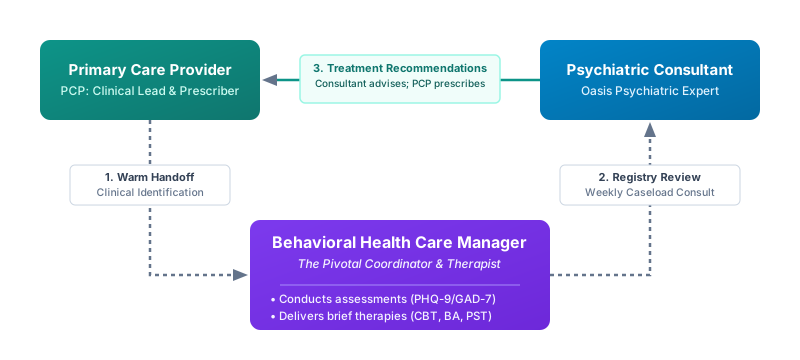
CoCM is a team-based, measurement-driven integration strategy that restructures how primary care clinics handle mental health. Rather than referring patients “out,” the model embeds specialized behavioral health staff into the primary care team. The model is structured around a “three-legged stool” of professionals:
- The Primary Care Provider (PCP): The clinic lead who continues to oversee the patient’s general care, prescribing medications and managing co-occurring physical conditions.
- The Behavioral Health Care Manager (BHCM): The clinical pivot point of the entire model, working directly within the primary care practice to coordinate care, track symptoms, and deliver brief therapies.
- The Psychiatric Consultant: A remote psychiatric expert (such as the clinicians at Oasis Health Services) who performs weekly caseload reviews with the Care Manager to optimize medication and treatment plans, ensuring that specialists’ time is utilized with maximum efficiency.
The Heart of the Model: The Behavioral Health Care Manager
In discussions of integrated care, the role of the Behavioral Health Care Manager (BHCM) is the most crucial, yet frequently misunderstood. The Care Manager is not simply a scheduler or receptionist; they are a highly trained clinical professional (often a licensed clinical social worker, professional counselor, or psychiatric nurse) who serves as the “glue” connecting the patient, the PCP, and the psychiatric consultant.
Here is exactly where and how the Care Manager fits into the CoCM workflow:
1. The Intake and Diagnostic Baseline
When a PCP identifies a patient struggling with mental health, they make a warm handoff directly to the Care Manager. The BHCM conducts the initial intake, building rapport and establishing clinical baselines using standardized screening tools, such as the Patient Health Questionnaire-9 (PHQ-9) for depression and the Generalized Anxiety Disorder-7 (GAD-7) for anxiety.
2. Registry-Based Caseload Tracking
Unlike traditional therapy, where a patient is seen for an hour and then disappears from the clinician’s radar, the Care Manager utilizes a clinical registry. This electronic tracking database monitors every patient’s scores, treatment milestones, and frequency of contact. If a patient’s PHQ-9 score fails to drop after several weeks, the registry flags them, prompting the Care Manager to escalate their treatment plan.
3. Delivering Evidence-Based Brief Interventions
The Care Manager is responsible for delivering short-term, structured psychotherapies. Rather than long-term psychoanalysis, they utilize brief, action-oriented interventions like:
- Cognitive Behavioral Therapy (CBT): Helping patients identify and reframe negative thought patterns.
- Behavioral Activation (BA): Encouraging patients to re-engage in activities that bring pleasure or a sense of achievement to counteract depressive withdrawal.
- Problem-Solving Treatment (PST): Equipping patients with practical skills to manage everyday stressors.
4. Direct Weekly Psychiatric Collaboration
Every week, the Care Manager meets with the remote Psychiatric Consultant. Together, they review the clinical registry, focusing on patients who are new to the practice or whose symptoms are not improving. The consultant recommends medication adjustments or specialized therapies. The Care Manager then translates these recommendations back to the PCP, who writes the prescriptions.
5. Proactive Outreach and Care Coordination
Between visits, the Care Manager is the patient’s primary point of contact. They monitor medication side effects, address barriers to treatment adherence (like transportation or pharmacy delays), and coordinate care across different medical specialists.
Clinically Proven: The Scientific Evidence
CoCM is not just a popular management theory; it is the most heavily researched model of integrated behavioral health in existence, backed by over 90 randomized controlled trials. Recent peer-reviewed research from 2024 and 2025 further highlights its clinical efficacy:
- Structured Therapy Contributions: A massive individual participant data meta-analysis published in JAMA Psychiatry analyzed data from over 20,046 adult patients across 35 trials. The researchers determined that structured, manual-based psychotherapy (delivered by the Care Manager) and active caregiver/family involvement are the key active ingredients that drive the model’s clinical success in reducing depressive symptoms (Schillok et al., 2025).
- Widespread Efficacy: A systematic review published in MDPI’s Healthcare journal confirmed that in 75% of analyzed studies, CoCM led to statistically significant improvements in depression, anxiety, and PTSD symptoms compared to standard primary care referral systems, verifying its long-term viability across diverse international clinic structures (Hernandez et al., 2024).
- Addressing Complex Comorbidities: The 2025 CHAMP trial published in JAMA Psychiatry demonstrated that when clinics integrated treatment for Opioid Use Disorder (OUD) directly into the CoCM framework, patients experienced a significant reduction in opioid use compared to traditional referral pathways, proving the model’s capacity to handle complex, high-risk cases (Fortney et al., 2025).
The Operational and Financial Case for Primary Care Partners
For primary care practices, partnering with a specialized mental health organization like Oasis Health Services to implement CoCM provides crucial operational and financial advantages:
1. Mitigating Clinician Burnout
By embedding a Care Manager to handle active symptom tracking, patient check-ins, and brief counseling, PCPs are freed from the overwhelming pressure of acting as sole mental health providers. They can practice at the top of their license, knowing they have specialized psychiatric support only a message away.
2. High-Efficiency Psychiatry
A single psychiatric consultant at Oasis Health Services can support a Care Manager overseeing a caseload of 80 to 100 patients. This task-sharing structure multiplies the reach of a single psychiatric specialist, bypassing the severe provider shortages that plague the healthcare landscape.
3. Sustainable Billing and Revenue Generation
CoCM is fully reimbursable under standard medical benefits, bypassing traditional mental health carve-outs. Primary care practices bill for the monthly cumulative time the Care Manager spends coordinating care (including patient calls, tracking symptoms, and reviewing the registry with the Psychiatric Consultant) using dedicated time-based CPT codes (such as 99492, 99493, 99494, and G2214).
Furthermore, under the 2026 CMS Fee Schedule, new integration add-on codes (HCPCS G0568–G0570) allow practices to seamlessly bundle collaborative behavioral health services alongside Advanced Primary Care Management (APCM) payments, establishing a stable, predictable revenue stream that offsets implementation costs.
The Oasis Partnership: Seamless Integrated Care
Implementing CoCM independently can be a daunting operational challenge. Hiring dedicated Care Managers, licensing registry tracking software, and retaining on-call psychiatric consults require significant upfront investment and administrative effort.
This is where a partnership with Oasis Health Services becomes invaluable. We provide flexible, turn-key solutions tailored to your clinic’s needs under two distinct models:
- Oasis-Provided Care Manager (Shared Staffing Model): Oasis employs and embeds a qualified Behavioral Health Care Manager into your practice’s workflow (physically or virtually). We also supply the Psychiatric Consultant and the software registry, removing all recruitment and management overhead from your practice.
- Primary Care-Employed Care Manager (Consultant-Only Model): If your clinic already has care management staff, you can employ the BHCM directly. Oasis provides the Psychiatric Consultant for weekly registry reviews, along with the HIPAA-compliant software registry and training support.
Through either collaborative model, your primary care practice can deliver gold-standard, evidence-based mental health support, optimize clinical revenue, and ensure that no patient falls through the cracks.
Establish a CoCM Partnership Today
If you are a primary care provider looking to integrate mental health services into your clinic, we invite you to connect with us. Visit our For Providers page to fill out our partnership inquiry form, or contact our clinical integration team to discuss how we can tailor the Collaborative Care Model to your practice.
References
- Schillok H, et al. (2025). “Effective Components of Collaborative Care for Depression in Primary Care: An Individual Participant Data Meta-Analysis.” JAMA Psychiatry. DOI: 10.1001/jamapsychiatry.2025.0183
- Hernandez V, Nasser L, Do C, Lee WC. (2024). “Healing the Whole: An International Review of the Collaborative Care Model between Primary Care and Psychiatry.” Healthcare. DOI: 10.3390/healthcare12161679
- Fortney JC, et al. (2025). “Collaborative Care for Opioid Use Disorder in Primary Care: A Hybrid Type 2 Cluster Randomized Clinical Trial.” JAMA Psychiatry. DOI: 10.1001/jamapsychiatry.2025.2126
- Centers for Medicare & Medicaid Services (CMS). (2026). Physician Fee Schedule and Billing Guidelines for Behavioral Health Integration (BHI). Baltimore, MD.